The evening star, Venus was occluded by the moon on Sunday, May 16, 2010. Here is how that good omen looked from
Fortune Island.
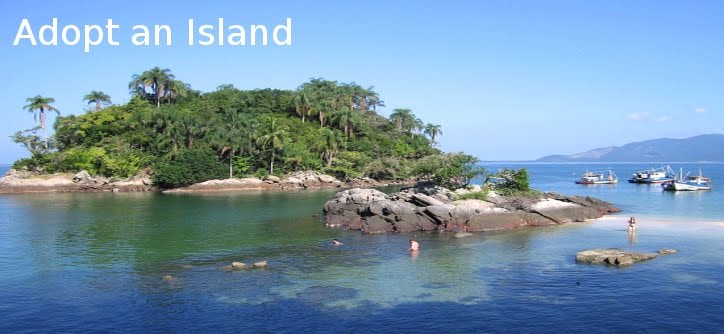
Tonight we shall delve a little bit deeper into Fortune Island, an island in the Philippines.
The 27-hectare (66.7-acre) island lies about 14 kilometers (8.7 miles) off the coast of Nasugbu, Batangas, Philippines. The island is located at Latitude: 14° 3' 0 N, Longitude: 120° 28' 60 E. It just smudge of grey on Google Maps.
Such a small island is more of a place to visit, to reconnoiter, than to live. No doubt fishermen have bivouacked on the island since time immemorial but no sustained village is there. There is the vivid ghost of a run down resort that now looks for revival.
The islands of this part of the world are littered with the remnants of unsustainable dreams; high end resorts that fade away when the glitter of some charismatic fortune is gone. Fortune Island is a classic example deserving of a sustainable revival.
So a small group of people are dreaming the vision of reviving the island and its environment the surrounding coral seas and fisheries. Long years of terrible practices, dynamite and cyanide fishing. have damaged but not destroyed the local coral reefs. Now the lovers of Fortune Island have ended these practices and slowly the coral and undersea life is recovering.
But let us look deeper into the problem. What in the beginning led to these practices? Simply the reality that a poor man, ignorant and struggling to feed his family, will no look long into the future. Nor did the developers of the island look beyond it becoming a play pen for the elite as an economic mechanism, a mechanism that has proven to be unsustainable.
Sad really.
But where are we now? What can be done? Ideally the island would simply be left alone to recover. Nature unmolested is a powerful mother and would give birth to a new fresh island in a century or so. But that won't happen. Humans won't leave an island like this alone.
Still a vision that features a small footprint on the environment, a future that is ecologically and economically viable is emerging. Here are some thoughts.
First, the people I met on the recent diving trip understand that ecotourism, bringing divers and other water buffs, island lovers to these coral reefs is wholly dependent upon the coral reefs and the underwater life that these corals sustain. They know they must be keepers of the coral and protect the coral from future damage. Ecotourism is one means, potentially sustainable, that will help rebuild the island ecology.
But I want to point out another, a more radical alternative. We are developing with the Internet the technology needed to redistribute work. That component of work that is primarily communications can be done almost anywhere that one has bandwidth. Moreover bandwidth is ever becoming more widely distributed, ever more available all over the world.
Now an concrete example of this is found right here in the Philippines. Every major corporation in the world sells something, a product or a service. All of those products need support. They have 800 numbers that connect with a human on a phone, somewhere. More and more of the English speaking support goes to the Philippines and India. This business, answering incoming phone calls, is just a hint of the reorganization of business that the future is bringing. The technical means exists to locate such communication oriented businesses anywhere.
Another example is software development. Give me intelligence and bandwidth and I can do software development anywhere. The growth of Free and Open Source Software, e.g. Linux, Gnu and its many applications is testimony to the power of the net to locate skilled intelligence anywhere that there is bandwidth.
See
Geographic distribution of Linux developers
Here is a table from an analysis of the geographic location of Source Forge developers
Region Developers
Africa 12560
Asia 127275
Europe 466792
North America 485679
Oceania 46422
South America 36330
While clearly biased toward historically dominant North America and Europe we see that large contributions are being made by the Rest of the World. This trend will grow as the Internet pushes more and more bandwidth to those parts of the world where intelligence is under utilized.
So what if Fortune Island were to become a Programmer's Paradise? A place where world class programmers could work in a beautiful environment, free from the harassments of urban life, in deep meditation, creating the future. Monasteries have always existed, dedicated to the intellectual and spiritual life. Why not on Fortune Island? Why not a secular monastery dedicated to software development? That I argue is a sustainable vision that could complement ecotourism.
I shall develop this theme further as this blog evolves.